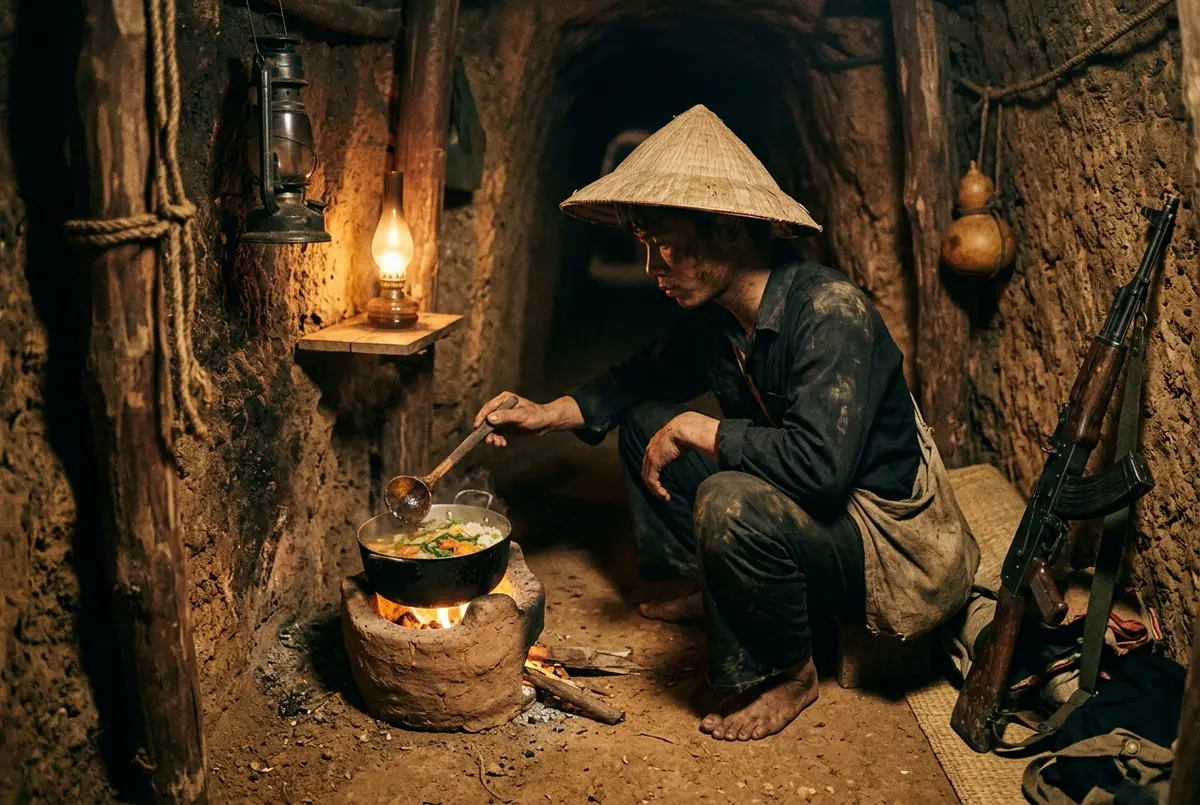
Life in the Cu Chi Tunnels meant spending days or even weeks underground in cramped, humid passages that doubled as kitchens, hospitals, sleeping quarters and command posts. Fighters cooked, healed, slept and planned operations in spaces barely tall enough to sit up in, using ventilation shafts and smokeless kitchens to stay hidden from patrols moving through the jungle overhead.
What Was Daily Life Like Inside the Cu Chi Tunnels?
Daily life underground revolved around staying quiet, staying hidden and making the most of very little space. Fighters slept in narrow side chambers cut into the tunnel walls, ate whatever the smokeless kitchens could prepare that day, and moved through the network mostly at night when the risk of discovery from aboveground patrols dropped. Heat, humidity and a near constant lack of fresh air made even simple tasks like eating or resting far harder than they sound.
Time underground was rarely continuous for any one person. Fighters rotated between tunnel duty and aboveground missions, so how did people live in the cu chi tunnels is really a question about weeks strung together in short stretches rather than one unbroken stay below ground.
How Did the Cu Chi Tunnels Kitchens Actually Work?
The tunnel kitchens used a clever venting system that channeled cooking smoke through a series of underground passages before releasing it well away from the entrance, spreading and cooling it so a plume of smoke never gave away a hidden entrance to aboveground patrols. This smokeless kitchen design, sometimes called the Hoang Cam stove after the soldier credited with refining it, is one of the exact stops every standard tour still walks visitors past today.
Meals cooked this way were simple by necessity: rice when it was available, foraged vegetables, and tapioca root boiled and eaten with salt and crushed peanuts, the same tapioca tasting most guided tours still serve visitors near the end of a visit. Cooking usually happened once or twice a day, timed around when smoke dispersal was least likely to be noticed.
What Did the Underground Hospitals Look Like?
Field hospitals built into the network handled everything from minor injuries to surgery, run by medics working with limited supplies and often makeshift tools in spaces not much bigger than a small room. Cu chi tunnels kitchens and hospitals shared the same underlying design challenge, fitting a task that normally needs space and airflow into a tight, low-oxygen tunnel chamber, and hospital sections tended to sit deeper in the network for extra protection from aboveground bombing.
Conditions were far from sterile by modern standards, and outcomes depended heavily on how quickly a wounded fighter could be brought underground and how serious the injury was. Even so, these underground hospitals kept the network functioning by treating fighters who would otherwise have had no medical care available at all.
How Did Ventilation Keep People Alive Underground?
Ventilation shafts, some disguised as termite mounds or hollowed out logs, pulled fresh air down into the network and let stale, smoke filled air escape without exposing an obvious opening at ground level. Without this system, extended stays in the deeper, more enclosed sections of the tunnels would have been dangerous simply from a lack of breathable air, aside from any risk from enemy action.
Airflow was never perfect, and fighters who worked or slept in tunnels for extended stretches often described the air as thick, warm and difficult to breathe deeply, a detail that visitors get a small taste of during even a short widened tunnel crawl on a modern tour.
Where Did People Sleep in the Cu Chi Tunnels?
Sleeping areas were narrow alcoves cut into the tunnel walls, just wide enough for one person to lie down, often lined with woven mats or simply packed earth. Privacy barely existed, and the constant threat of aboveground search operations meant sleep was frequently interrupted, light and never fully restful even during quieter stretches of the war.
Command areas and more heavily used sections of the network tended to have slightly larger sleeping quarters, since senior fighters and planners sometimes needed to stay underground for longer continuous periods while coordinating operations across the district.
How Did People Get Food and Supplies Underground?
Supplies moved through the tunnel network along the same routes fighters used to travel, carried in by hand from surface caches, nearby villages or supply lines connected to the wider resistance network. Rice, salt, medicine and ammunition all had to be rationed carefully, since aboveground search operations could cut off a section of the network from resupply for days or weeks at a time.
Villagers living above the tunnels played a direct role in keeping this supply chain running, often at significant personal risk, which is part of why the tunnel network functioned as much as a community effort as a purely military one.
Why Did Fighters Build Multiple Levels Underground?
More heavily developed sections of the network went down two or three levels, connected by narrow vertical shafts, so that deeper levels offered better protection from aboveground bombing and flooding while shallower levels stayed useful for quick movement and access to trapdoors near the surface. Living, sleeping and working underground meant constantly weighing depth against how quickly you could reach an exit if a patrol got close.
What Psychological Toll Did Underground Life Take on Fighters?
Extended stretches underground brought real psychological strain from constant darkness, cramped space, poor air and the ever present risk of discovery, on top of the physical toll of heat and humidity. Accounts from fighters who lived this way describe both dread and a strange adaptation to the conditions, since staying underground for long enough eventually became the more familiar, safer feeling compared with time spent exposed aboveground.
This human side of the network is easy to miss on a fast paced group tour focused mainly on the trap displays and the tunnel crawl, but it is arguably the detail that gives the site its lasting weight for many visitors.
Did Families Live in the Cu Chi Tunnels Too?
Yes, in some of the more established sections of the network, entire families sheltered underground for stretches of time, particularly during periods of heavy aboveground fighting or bombing in Cu Chi District. Children grew up spending significant time below ground, learning early which sounds meant danger and which meant it was safe to surface.
This detail often surprises visitors who assume the tunnels were purely a military space. In reality, the network supported a much broader slice of the local community than just armed fighters, a point our Viet Cong guide at Who Were the Viet Cong? The People Behind the Cu Chi Tunnels expands on in more detail.
What Artifacts From Daily Underground Life Can You See Today?
Preserved sections at Ben Dinh and Ben Duoc display reconstructed kitchens, sleeping alcoves and storage areas alongside the more commonly photographed trapdoors and booby traps, giving visitors a fuller sense of what day to day survival underground actually involved. Guides on most tours point out these details as you walk the jungle trail, though it is easy to miss the significance without a bit of background beforehand.
Our booby traps guide at Guerrilla Warfare and Booby Traps at Cu Chi covers the defensive side of the network in more detail, a natural companion to the daily life picture covered on this page.
How Does Understanding Daily Life Change What You See on a Tour?
Knowing that the kitchen you are looking at fed people hiding from active bombing raids, or that the narrow alcove nearby was someone’s bed for weeks at a time, turns a walk through reconstructed tunnels into something closer to a real historical encounter rather than a curiosity stop. Visitors who read up on daily underground life beforehand consistently report getting more out of the guided walk than those who arrive without any context.
If this human side of the story has you ready to see the tunnels in person, browse the cu chi tunnels tour options on our homepage, including the standard half-day trip that walks the same kitchens and rest areas covered here.
What Other Cu Chi Tunnels History Guides Should You Read?
Daily underground life connects closely to a few other pages worth reading before or after your visit:
Background on the wider tunnel network these daily routines supported is available on Wikipedia’s Cu Chi tunnels page, a useful next step for readers who want the fuller historical picture.
Ready to walk the same ground? Browse every cu chi tunnels tour format, from the standard half-day trip to more private options, on our Cu Chi Tunnels tour homepage before you book.
Frequently Asked Questions
What was daily life like in the Cu Chi Tunnels?
Fighters and some families lived, cooked, slept and received medical care underground for stretches of days or weeks, rotating with aboveground duties and relying on ventilation shafts and smokeless kitchens to stay hidden.
How did the smokeless kitchens in the Cu Chi Tunnels work?
Cooking smoke was channeled through underground passages and released well away from the entrance, spreading and cooling it so it would not reveal a hidden tunnel opening to aboveground patrols.
Did the Cu Chi Tunnels have hospitals?
Yes, field hospitals treated injuries and performed basic surgery underground using limited supplies, usually placed deeper in the network for extra protection.
Did families live in the Cu Chi Tunnels, or only fighters?
Some families sheltered underground for extended periods, particularly during heavy fighting, so the network supported a broader slice of the local community than armed fighters alone.
Can visitors see the kitchens and sleeping areas on a tour today?
Yes, reconstructed kitchens, sleeping alcoves and storage areas are part of the standard walking route at both preserved sites, alongside the more commonly photographed trapdoors and traps.