Cu Chi Tunnels history stretches back further than most visitors expect, starting as simple hideouts dug during the resistance against French colonial rule in the late 1940s, then expanding into a sprawling underground network during the Vietnam War that grew to stretch over 120 kilometers across Cu Chi District.
When Were the Cu Chi Tunnels First Built?
The earliest tunnels at Cu Chi date to the late 1940s, during the First Indochina War, when Viet Minh fighters dug basic hideouts and storage pits to move and shelter away from French colonial forces. These first tunnels were relatively simple, built mainly for short-term concealment rather than the elaborate multi-purpose network that would come later.
Cu Chi’s terrain made it a natural fit for this kind of underground activity from the start. The district’s dense red clay soil holds its shape well when tunneled, resisting collapse far better than sandier ground would, which is part of cu chi tunnels origin as a defensible hiding network rather than a coincidence of geography.
How Did the Cu Chi Tunnels Expand During the Vietnam War?
The network expanded dramatically from the early 1960s onward as cu chi tunnels vietnam war activity intensified, with Viet Cong forces digging new sections to connect existing hideouts into a much larger, interlinked system. What began as scattered pits and short passages grew into a network capable of housing fighters for extended periods, moving supplies, and hiding entire units from aboveground search operations.
Cu Chi’s location, close enough to Saigon to strike quickly but remote enough to hide extensively, made the district one of the most heavily contested areas of the entire war, which in turn drove the tunnel network’s rapid growth throughout the 1960s.
How Were the Cu Chi Tunnels Actually Built?
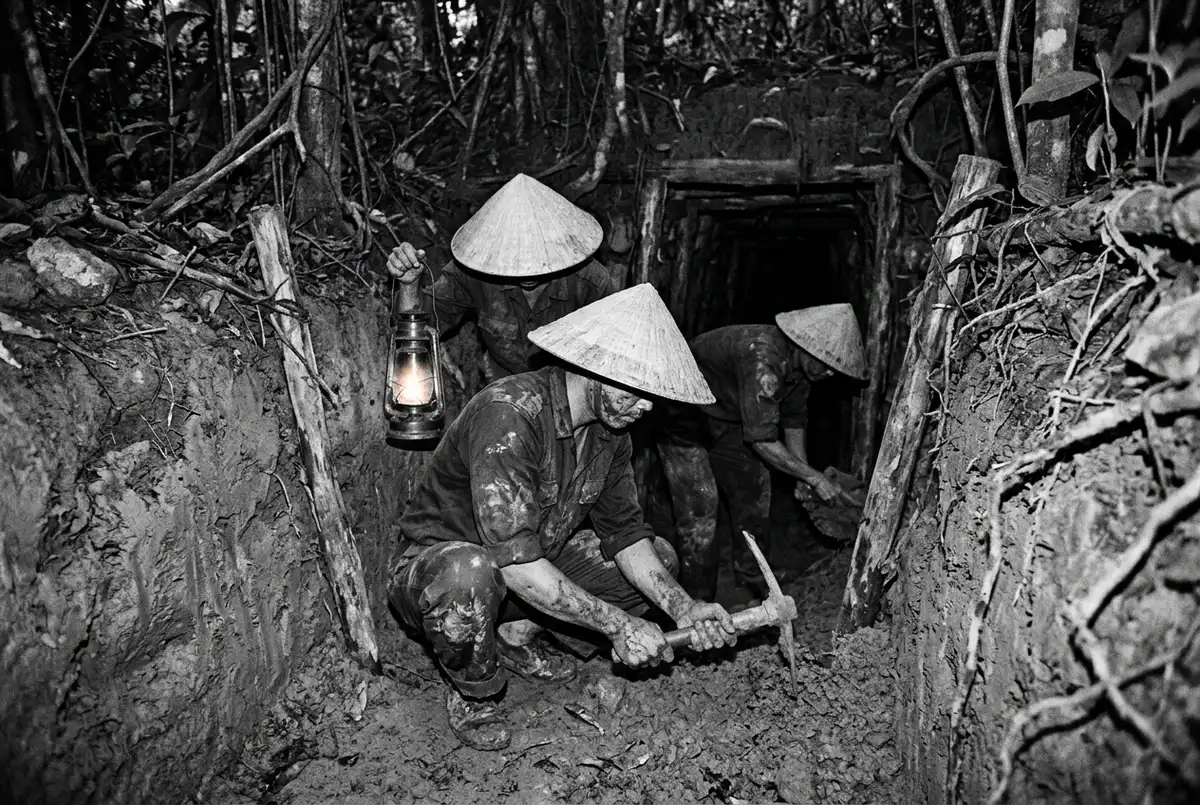
Digging was almost entirely manual, using simple hand tools to carve narrow passages through the district’s dense clay soil, then reinforcing weak sections and disguising entrances with foliage, false floors and camouflaged trapdoors. Ventilation shafts, some disguised as termite mounds or hollow logs, kept air moving through sections that could otherwise become dangerously stale.
Kitchens built into the network used a design that vented cooking smoke through a series of underground channels before releasing it well away from the entrance, spreading and cooling the smoke so it would not give away a tunnel’s location to aboveground patrols. This same smokeless kitchen system is one of the stops every standard tour still walks visitors past today.
Why Did the Tunnel Network Stretch So Far Across Cu Chi District?
By the height of the war, the combined network of tunnels across Cu Chi District is estimated to have stretched over 120 kilometers, linking villages, command posts and supply routes into a single system that fighters could move through largely unseen. This scale let the network function less like a single hideout and more like an underground extension of the district itself, complete with living quarters, meeting rooms, storage areas and field hospitals.
Connecting so many separate digging efforts into one continuous system took years of ongoing work, which is part of why the tunnels grew unevenly, with some sections far more elaborate and multi-level than others depending on how heavily that particular area was used.
What Made Cu Chi Such a Strategic Location?
Cu Chi sits close enough to Saigon that fighters using the tunnel network could stage operations near the city and disappear underground again before a response arrived, making the district a persistent, difficult to eliminate threat throughout the conflict. Its position along supply routes connecting toward the wider resistance network only added to its strategic value.
This proximity to a major city, combined with terrain that supported extensive tunneling, is a big part of why Cu Chi specifically, rather than other districts, became home to one of the most extensive underground networks of the entire war.
What Were “Tunnel Rats” and Why Did They Exist?
American and allied forces created specialized units, nicknamed tunnel rats, tasked with entering and clearing sections of the network by hand, armed with little more than a pistol, a knife and a flashlight in passages too narrow for most standard equipment. The job was recognized even at the time as exceptionally dangerous, given the risk of booby traps, ambush and the sheer difficulty of navigating a dark, unfamiliar tunnel system built specifically to disorient outsiders.
The existence of tunnel rats says as much about the tunnel network’s effectiveness as any other single detail from the war. A force built and equipped for large-scale, aboveground combat still needed dedicated underground specialists just to contest a network dug largely by hand.
What Did a Typical Level of the Tunnel System Include?
Beyond simple passageways, sections of the network included underground kitchens, meeting rooms, sleeping quarters, storage areas for weapons and supplies, and in some locations, field hospitals capable of basic medical care. Trapdoors and hidden entrances, some barely larger than a rucksack, let fighters disappear from view in seconds when aboveground patrols came close.
Our companion guide, Life Underground: Daily Life in the Cu Chi Tunnels During the War, covers what day to day existence actually looked like inside these spaces, useful reading if the logistics of underground living interest you beyond the tactical side covered here.
Did the Tunnels Have Multiple Levels?
Yes, in the more heavily developed sections of the network, tunnels were dug on multiple levels, sometimes three layers deep, connected by narrow vertical shafts rather than a single flat passage. Deeper levels offered better protection from aboveground bombing and flooding, while shallower levels were often used for quicker movement and access to trapdoors near the surface.
Not every stretch of the 120-plus kilometer network reached this level of complexity. Multi-level sections tended to cluster around command areas and heavily used supply routes, while more peripheral stretches stayed closer to a single, simpler passage.
What Happened to the Tunnels After the War Ended?
Large sections of the network fell into disuse after the war ended in 1975, with tunnels collapsing naturally over time or being deliberately filled in as the district returned to agricultural use. The sections preserved today at Ben Dinh and Ben Duoc represent a small, maintained portion of what was once a much larger system, widened and reinforced specifically to let visitors experience the tunnels safely rather than left in their original wartime condition.
How Did the Tunnels Become a Tourist Site?
Vietnam began developing the preserved sections at Ben Dinh and Ben Duoc into a public historic site in the years following the war, adding a documentary screening, guided walking routes and widened crawl sections so visitors could experience the network without the risks the original tunnels posed. Over time, the site grew into one of the most visited attractions near Ho Chi Minh City, drawing travelers curious about a very different side of the war than a museum exhibit alone can convey.
Both preserved sites include widened tunnel sections for crawling, reconstructed trapdoors and booby trap displays, and the smokeless kitchen system, alongside a short documentary explaining the network’s origins and wartime role. Ben Duoc additionally preserves a war memorial complex next to its tunnel entrance, a distinct historical layer that goes beyond the tunnels themselves.
Why Does the History of Cu Chi Still Matter to Visitors Today?
Understanding the tunnels’ history changes what you actually see when you walk the jungle trail and crawl through a widened passage, turning an otherwise unlabeled dirt tunnel into a physical record of decades of conflict, ingenuity and survival. Visitors who read up on the network’s origins beforehand tend to get far more out of the guided walk than those who arrive without any context at all.
If this history has you ready to see the tunnels firsthand, our half-day tour guide at Cu Chi Tunnels Half-Day Tour: Morning vs Afternoon Departure covers exactly what a standard guided visit includes and how to choose between a morning or afternoon departure.
How Did Cu Chi’s Tunnels Draw International Attention?
Foreign journalists, historians and eventually filmmakers took a growing interest in Cu Chi in the decades following the war, drawn by how completely a network dug largely by hand had managed to resist a far better equipped conventional force for so long. That interest helped push the preserved sections at Ben Dinh and Ben Duoc toward becoming a public historic site rather than simply abandoned, overgrown ground.
Books, documentaries and firsthand accounts from both sides of the conflict have continued to shape how the wider world understands Cu Chi’s role, often focusing as much on the ingenuity of the tunnel builders as on the underlying tragedy of the war itself. Visitors arriving today are usually walking into a site that carries decades of this outside attention alongside its own local history.
What Artifacts and Displays From This Era Can You See Today?
Preserved sections at both entrances display reconstructed trapdoors, a range of handmade booby traps once used to slow aboveground patrols, and examples of the smokeless kitchen system that let fighters cook without giving away a tunnel’s position. Some tours also pass display cases holding uniforms, tools and other period items connected to daily life underground, giving a physical sense of scale to details that can otherwise feel abstract when only described in a guidebook.
None of these displays are the original wartime tunnels in their unaltered state. Every section open to visitors has been deliberately widened, reinforced and lit for safety, which is worth keeping in mind as a difference between the historic site you walk through and the much narrower, unlit passages fighters actually used decades ago.
How Do Local Communities Remember This History Today?
Communities around Cu Chi District still carry a direct connection to this history, since many families in the area either took part in building and using the tunnels or lived through the war’s impact on the district firsthand. Local guides working the site today often draw on family stories passed down from that generation, adding a personal layer to the standard tour narration that a purely academic account would not capture.
This local dimension is part of why the Ben Duoc memorial complex, with its wall of names tied specifically to the surrounding area, resonates differently than a general war museum exhibit might. The history here is not abstract for the communities living around it, and that context is worth carrying with you as you walk the same ground.
How Accurate Are Modern Depictions of the Cu Chi Tunnels?
Films, books and even some tour narrations occasionally simplify or dramatize aspects of the tunnels’ history for a general audience, which is worth keeping in mind alongside the more grounded, source-based account covered on this page. The core facts, the anti-French origins, the wartime expansion, the multi-level construction and the eventual preservation of Ben Dinh and Ben Duoc, are well documented and consistent across serious historical accounts, even where dramatized retellings add embellishment for effect.
Visitors who want the fuller picture beyond a single tour narration are well served by reading a bit before or after their visit, since a guide’s spoken account on a busy group tour rarely has time to cover every nuance that a dedicated history page or book can.
How Long Should You Spend Learning About Cu Chi’s History Before Visiting?
Even 20 to 30 minutes spent reading an overview like this one before you go changes how much you get out of the on-site documentary and guided walk, since you arrive already able to place the trapdoors, kitchens and tunnel levels into a larger story instead of encountering each detail cold. The site’s own introductory film covers a condensed version of this history, but it moves quickly and is easy to miss details from if this is your first exposure to the topic.
Readers planning a visit soon should treat this page, along with the companion guides linked below, as a short primer rather than a full substitute for the documentary and guided narration you will get on site. The two are meant to complement each other rather than repeat the same ground twice.
What Other Cu Chi Tunnels History Guides Should You Read?
The full story of the tunnels spans more ground than one page can cover on its own:
Background on the wider conflict connected to this network is available on Wikipedia’s Cu Chi tunnels page, a useful starting point for deeper reading beyond this overview. Reading a primary source alongside a tour operator’s own summary is generally good practice for any historical site, since it gives you an independent check on the details a guide presents on the day.
Ready to see the network for yourself? Browse every cu chi tunnels tour format, from the standard half-day trip to the quieter Ben Duoc alternative, on our Cu Chi Tunnels tour homepage before you book.
Frequently Asked Questions
When were the Cu Chi Tunnels first built?
The earliest sections date to the late 1940s, during the resistance against French colonial rule, before the network expanded significantly during the Vietnam War.
How long did the Cu Chi tunnel network eventually stretch?
Estimates put the combined network at over 120 kilometers across Cu Chi District at its height, linking villages, command posts and supply routes.
Were the Cu Chi Tunnels built by hand?
Yes, digging was almost entirely manual, using simple hand tools to carve passages through the district’s dense clay soil, then reinforcing and camouflaging the entrances.
What were tunnel rats?
Specialized American and allied soldiers tasked with entering and clearing sections of the tunnel network by hand, a role considered extremely dangerous at the time.
What happened to the tunnels after the war?
Most of the network fell into disuse or collapsed naturally over time. The sections preserved at Ben Dinh and Ben Duoc today were widened and reinforced specifically for visitors.