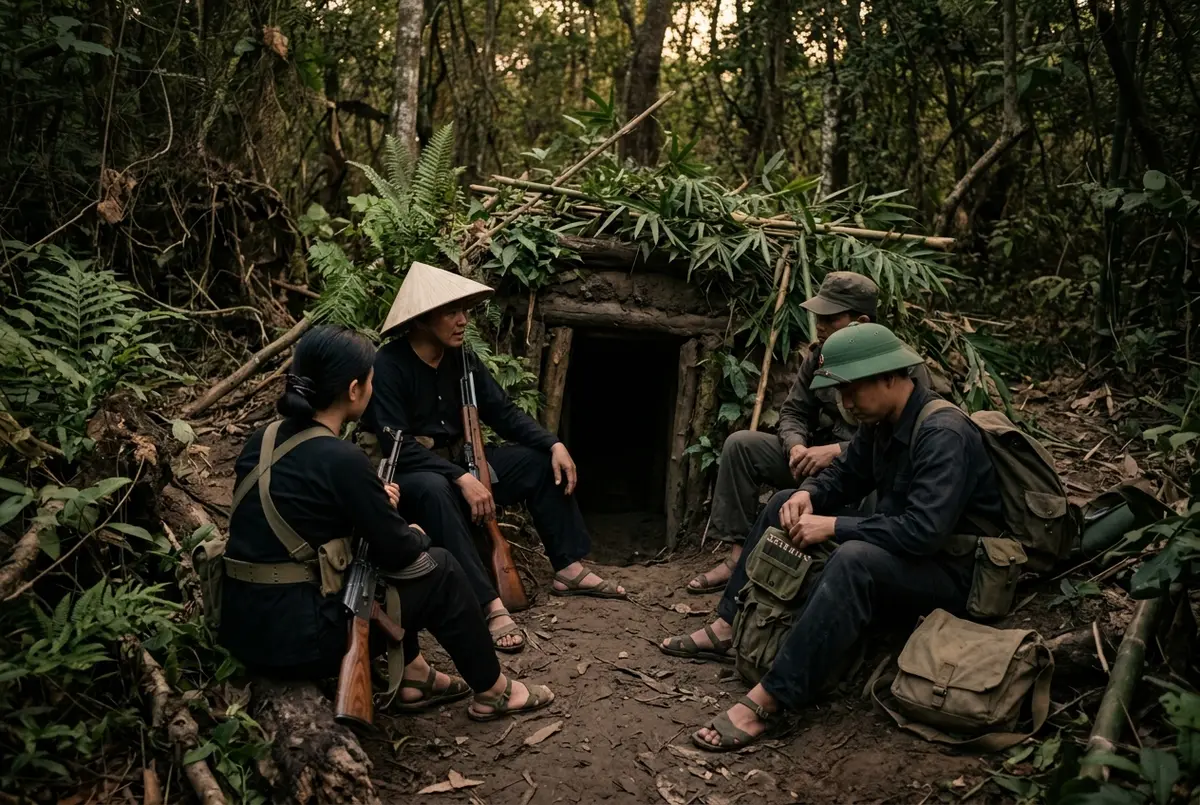
The Viet Cong at Cu Chi Tunnels were local guerrilla fighters, many from villages in and around Cu Chi District itself, who dug and expanded the network as part of a wider resistance movement against South Vietnamese and American forces during the Vietnam War. Understanding who these fighters actually were, not a distant army but often a farmer’s neighbor or relative, changes how you see the tunnels once you are standing at the entrance.
Who Were the Viet Cong?
The Viet Cong was the common name for the National Liberation Front, a communist backed guerrilla movement that fought alongside North Vietnamese forces against the South Vietnamese government and its American allies. Rather than a single standing army, the Viet Cong operated as a network of local fighters embedded within villages and districts across South Vietnam, blending into the civilian population between operations.
Cu Chi District became one of the movement’s most important strongholds precisely because of this local embedding. Fighters here were often farmers or villagers by day, drawing on deep knowledge of the terrain and community support that a conventional outside force simply could not match.
Who Built the Cu Chi Tunnels?
Who built the cu chi tunnels is really a story about local labor rather than a single engineering effort. Villagers and fighters across Cu Chi District dug the network almost entirely by hand, using simple tools to carve through the area’s dense clay soil over years of ongoing, often dangerous work. Digging happened in stages, driven by immediate tactical need rather than a single master plan, which is part of why the network grew unevenly across the district.
Entire communities contributed to this effort in different ways, from the fighters doing the actual digging to families providing food, shelter and warning of aboveground patrols. The tunnels were as much a community project as a purely military one.
Why Did Local Villagers Support the Viet Cong Tunnel Network?
Support came from a mix of ideological commitment, family ties to fighters, and the practical reality of living in a heavily contested district where cooperation with the resistance often felt safer than open opposition to it. Many villagers had direct relatives fighting or already lost to the conflict, making support for the tunnel network personal rather than purely political for a large share of the local population.
This deep local support is a major reason the viet cong tunnel network at Cu Chi proved so difficult for aboveground forces to fully suppress, since intelligence, supplies and warning of incoming patrols moved through community channels that outside forces struggled to penetrate.
How Did the Viet Cong Organize Life Around the Tunnels?
Fighters rotated between tunnel duty, aboveground missions and periods spent living more openly within villages, rather than remaining underground continuously. Command structures existed within the network, coordinating operations, supply movement and defense across a district-wide system rather than isolated, disconnected pockets of resistance.
What Weapons and Tactics Did the Viet Cong Use at Cu Chi?
Fighters relied on a mix of captured and supplied small arms, alongside handmade traps and mines built from available materials like bamboo and scavenged metal. Tactics emphasized ambush, quick retreat underground and avoiding prolonged direct engagement with better equipped aboveground forces, a strategy built around attrition rather than decisive battles.
Yes, women served in combat, support and intelligence roles throughout the Viet Cong movement at Cu Chi, including well documented cases of women leading tunnel sections or organizing local resistance cells. This was not a minor or symbolic role, since women’s involvement was substantial enough that some of the most recognized figures from Cu Chi’s wartime history are women who served directly in the network.
This detail often surprises visitors who arrive expecting a purely male military history, and it is worth keeping in mind as you walk through a site shaped by a genuinely broad slice of the local community.
How Did the Viet Cong Avoid Detection at Cu Chi?
Camouflaged trapdoors, false floors and entrances disguised as termite mounds or natural jungle features kept most tunnel openings hidden from aboveground search operations. Fighters also relied heavily on community cover, blending into village life between operations so that identifying an active fighter from a farmer going about ordinary business was genuinely difficult for outside forces.
This combination of physical concealment and social embedding is a big part of why the network at Cu Chi proved so resilient throughout years of aboveground search and bombing operations.
What Happened to Viet Cong Fighters After the War?
Many surviving fighters returned to civilian life in and around Cu Chi District once the war ended in 1975, some going on to work at the preserved tunnel sites as guides sharing firsthand or family accounts with visitors. Others moved into different work entirely, carrying their wartime experience privately rather than as part of the tourist site’s public history.
This continuity between the wartime generation and the site’s present day guides is part of why some tours carry a personal, first hand quality that a purely academic history lecture would not.
How Do Local Communities Around Cu Chi Remember This History?
Families across Cu Chi District still hold direct memories and stories connected to the tunnel network, whether through relatives who fought, supported the resistance, or lived through the district’s heavy wartime impact firsthand. This local memory adds a personal weight to the site that goes beyond what a general war museum exhibit typically conveys.
The Ben Duoc memorial complex, with its wall inscribed with local names, reflects this community connection directly, a detail worth keeping in mind if that stop is part of your visit.
Why Does Knowing Who the Viet Cong Were Change How You See the Tunnels?
Understanding that the network was built and defended by local farmers, families and villagers, not a distant conventional army, reframes the trapdoors, kitchens and tunnel crawl you experience on a tour as evidence of a genuinely community driven resistance effort. Visitors who read into this background beforehand consistently describe getting more out of the visit than those who treat it as a purely physical, hands on stop.
Background on the movement’s broader role in the war is available on Wikipedia’s Viet Cong page, a useful starting point for readers who want deeper historical context beyond this overview.
Ready to see the network these fighters built? Browse every cu chi tunnels tour format, from the standard half-day trip to more private options, on our Cu Chi Tunnels tour homepage before you book.
Frequently Asked Questions
Who were the Viet Cong at Cu Chi?
Local guerrilla fighters, many from villages in and around Cu Chi District, who fought as part of a wider communist backed resistance movement against South Vietnamese and American forces.
Who actually built the Cu Chi Tunnels?
Local villagers and fighters dug the network almost entirely by hand over years of ongoing work, driven by immediate tactical need rather than a single master plan.
Did women serve as Viet Cong fighters at Cu Chi?
Yes, women served in combat, support and intelligence roles, including documented cases of women leading tunnel sections or resistance cells.
Why did local communities support the tunnel network?
Support came from a mix of ideological commitment, family ties to fighters, and the practical reality of living in a heavily contested district.
Do any former fighters still work at the Cu Chi Tunnels today?
Some surviving fighters and their families have worked as guides at the preserved sites, sharing firsthand or family accounts as part of the visitor experience.